
Rethinking Fit: Why I Stopped Chasing the Smallest Size
Read any style column or listen to any style expert, and the importance of well-fitting clothing is bound be mentioned. (Even if it’s often invoked without being defined.) It’s true that even expensive clothes can look awkward if the fit is poor on the wearer. But how do we determine “what fits” in an age where so many different styles and silhouettes co-exist?
What “Well-Fitting” Used to Mean
Traditionally, in Western cultures, “well-fitting” meant a tailored silhouette that (with some exceptions) lay close to the body, while allowing movement without pulling or bunching. Which in our age of mass-produced clothing can be hard to achieve unless one sews their own clothing, or has the means to have pieces custom-made.
Today, that narrow ideal can feel onerous and exclusionary. Our lifestyles are much more casual. And our clothes often have to multi-task. Not to mention the comfort factor: in my post last week about styling drawstring pants, many of you mentioned in comments that you’ve also become more sensitive and turned off to clothing that feels stiff or constricting.
Why the Smallest Size Isn’t the Goal
What constitutes a good fit can vary from person to person. But I think for a lot of women in our age demographic, it’s often been interpreted as “wearing the smallest size you can get into,” with the goal of looking smaller. Wearing clothes with more ease can feed into that fear that we’re “giving up.”
I’ll admit this has been a fraught topic for me. A bit of personal history: beginning when I was about 12 or 13 years old, my mother decided that buying my clothes in a slightly-too-small size would encourage me to lose weight. (And on top of that, girls my age were already starting to get competitive about who wore the smallest size.) I started dieting strenuously at 13, which led to eating disorders and fluctuating weight. There were days and weeks when I could barely fasten anything in my wardrobe. I’d sit through school in painfully constricting clothing that also caused intestinal distress. Or, I’d wear my one pair of denim overalls day after day, while feeling an immense amount of shame.
So for me, prioritizing comfort comes from a very deep place. But comfort doesn’t have to mean “shapless and baggy.”
What Is “Fit?” (tell me, tell me, if you think you know)*
When current fashions include both oversized and body-hugging shapes, how do we determine what constitutes a good fit? You’re probably going to hate this answer (I sometimes do), but to a large degree, it depends on your personal style and preferences. To me, good fit means a piece moves with your body instead of against it, without pulling, gaping, or shifting all day. It’s almost easier to define markers of poor fit.
The Real Markers of Poor Fit
- Gaping between buttons and creases from too-tight clothing
- Pieces that constantly shift or ride up and have to be re-adjusted
- Shoulder seams on set-in sleeves that land above or beyond the shoulder line (though I’ll stipulate that some padded shoulders may be a skosh wider than the natural shoulder line)
- Anything that restricts movement (e.g. something you can’t comfortably sit in, or a jacket that is too tight across the back to comfortably cross your arms)
- Side seam pockets on pants that gape open
- Waistbands that dig in, or conversely, gape in the back
- Hemlines that land at an awkward point on the body
(I’m sure we can all think of a few more of our personal fit peeves, but those are what spring to my mind.)
Just a Number
Remember, the number on the tag is arbitrary and meaningless. Getting the fit you want is more important than whether everything in your closet is a certain size. And even if our weight stays constant, our shape can change over time.
So here’s a radical notion: don’t be afraid to size up. Even if my usual size fits, I’ve been finding that sometimes going up a size (especially in pants) results in a piece that drapes better on my body. And with today’s meager seam allowances, it’s often easier to take in a piece where needed than to let it out.
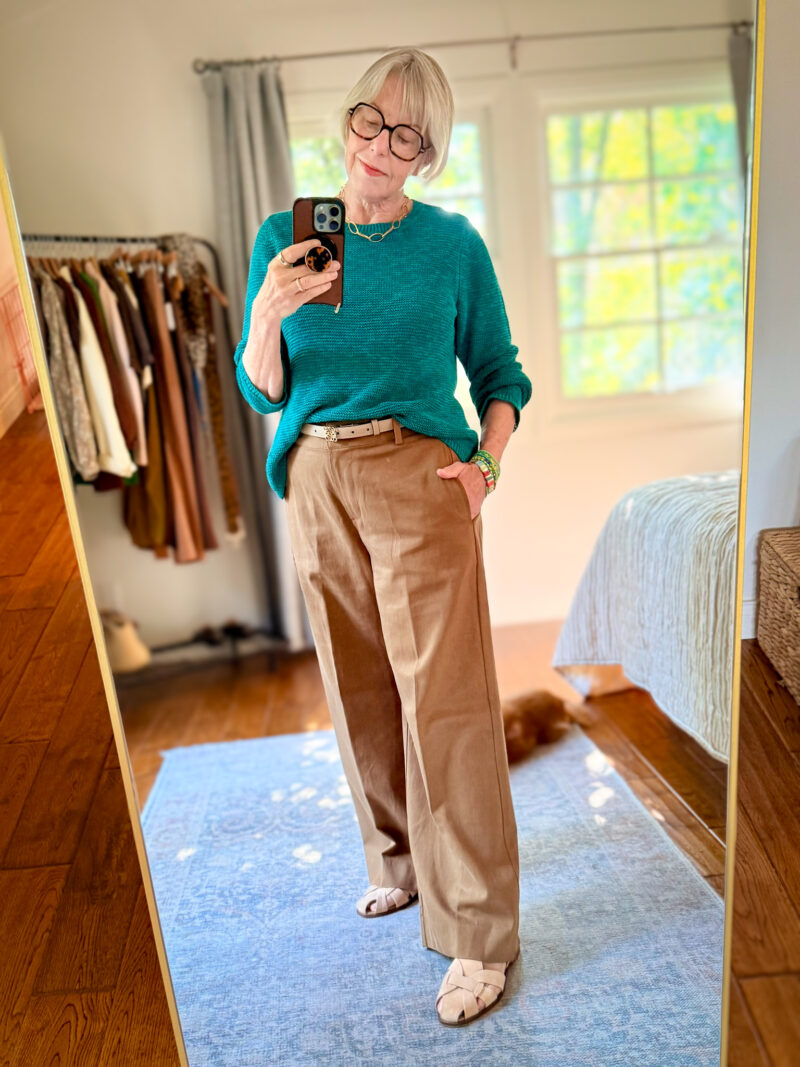
My sizes: Sweater – XS, Pants – Petite M (sized up one size)
Case in point: these trousers. I could go down a size, but I prefer the slouchiness here and the way the fabric moves. And there’s enough room that when I put my hand in the pocket, nothing pulls or strains across the front. (And even though the sweater is slouchy, the fit in the shoulders adds structure and keeps it from swallowing me.)
Sometimes, what feels “shapeless” can be a lack of structure, rather than a too-large garment. I’ve offered some tips to add structure to your outfits here: The Secret to Smart Casual: Adding Structure Without Sacrificing Comfort And yes, outfit proportions matter too. But this is already quite long, so I’ll cover that in a separate post soon. 😉
What are your non-negotiables when it comes to fit? Let me know in comments below.
*And if you now have a Tower of Power song running through your head, enjoy! 🎵 One of my favorite concerts ever, 1975 at the Circle Star theater in the Bay Area. Rufus with Chaka Khan was the opening act.


Stay in touch
Sign up to be notified of new posts and updates from une femme d’un certain âge.
For me, it’s the waistband. Being an Apple shape it’s often tight but going up a size makes it baggy in the seat. So elastic waists it tends to be, although sometimes I do want to look more polished.
Me, too, Julia! I’ve tried some denim shorts and jeans recently from Wit and Wisdom. The elastic waists are hidden!
I agree with some other commenters that dropped shoulders are not flattering on us busty girls. I refuse to buy any tops with dropped shoulders. Another challenge for me when buying tops is finding those that don’t cling but also don’t look like tents and at the same time are a good length (without tucking) for my 5′ 2″ frame.
I don’t like dropped shoulders either. It seems almost all toos these days have them.
That’s my problem too. My hips are only four inches larger than my waist and I struggle to find pants that fit me!
Thank you for pointing this out! I could never understand “WHY” I don’t like a dropped shoulder on me! I’ll add that to my “tool chest” fo knowledge and what looks best on my glorious form!
Bravo! Excellent points Susan.
My non-negotiable is the pulling and gaping across the bust. Being a 34H bra size, this happens to me a lot, I find it uncomfortable as well as unsightly.
I don’t think that I wanted a vanity size as much as I was in denial about gaining weight in my late 40’s- “if I can still fit in this size 10 then I haven’t gained weight”. Fortunately, that’s all sorted now. I still struggle with pockets not lying flat in some brands that seem to fit everywhere else, not sure why those pockets are even there.
I’ve come to realize the notion that clothes should be “slenderizing”’or make you look taller and skinnier is purely to please men and be chosen. (A “pick me” as the youngs say). Sure, I like to look nice, but it’s to please me! I agree with you about the elements of good fit. For me (petite and big busted) the most important elements are fit in the shoulders and correct rise. I’m done with the drop shoulders in all but the most flowy fabrics. That dropped seam just juts right out. I’m sorry you went through so much at a young age. I find many of the older generations (gaged by comments from folks I follow who are around 70) will never change on this issue. I’m 60, have a child in college, and I can tell you Gen Z are the most comfortable in their bodies of any generation I have seen. They are so accepting and free. That’s why Hollywood is back to imposing thinness. Back to controlling women. Down with the patriarchy!
Yes!!!!!!!!!!!!!!!!!!!!!
This!
💯!!!
Agreed.
Great post! I really needed to hear this…thank you!
If I can’t button or snap the waistband without sucking in my stomach, then I can’t wear it. I will be uncomfortable all day. I will take a baggy bottom over a pinched waist! So I tend to size up quite a bit. Thanks for making me feel better about this!
I’m sure all of us have our non negotiables for clothing comfort by this time! For me, it’s petite sizing. So many nice manufacturers have eliminated this crucial size. I’m done with making something fit with alterations. For this reason I mostly rely on Eileen Fisher for casual elevated that fits my needs.. I also prioritize natural fibers ! Thank you Susan for another great post.
I’m with you on the lack of petite sizing! So disappointing. Back in the day, Liz Claiborne, was fashionable and came in petites. Then it was sold to a larger co, sizing and style went downhill and then the brand disappeared
This has happened to Talbot’s and Chico’s too: same parent company, and quality and fit have significantly declined overall.
Susan I’m so glad that you addressed the size issue. I think it was your good example that allowed me to size up in pants. I was definitely *in competition* (needlessly!) with a couple of girlfriends. It’s taken a lifetime for me to admit that my body is built differently than the standard model. Comfort is non negotiable for me now. So thank you for your wise and benevolent example! The big top with slouchy pants is definitely a look that I enjoy these days but the shirt/top does have to have some structure–I’ve learned this from you and Annie as well. Thank you for your excellent example! And BTW, I remember one summer when my aunt put me and my two cousins (ages 13 and 16) on the diet that she found in Vogue–along with the exercises (this is pre Jane Fonda!) that we had to do every day!
Hi Susan,
Great column today. May not be completely relevant to today’s post, but I had to share/vent.
I just ordered, and then returned, two blazers from the Nordstrom Anniversary Sale. Ordered what should have been my size ( I’m a 12, but take a 14 in jackets)…size large in both said 12-14 in the size guide.
Gorgeous blazers…one from Ralph Lauren, one Nordstrom’s brand. Beautiful fabric and construction on both. However……shoulders were perfect, sleeves spot on. I couldn’t button either one. Now, I wear a 38DD bra, so I have a chest….but a four inch gap????
Am I that out of touch with my size, or are fit models just not realistic anymore?
Note that all my older blazers fit beautifully..I can button them, they are sizes 12/14/large/ medium.
Thanks for listening…
Cheryl, i’m glad you brought up blazer fit issues. I haven’t been successful with buying a blazer in a long time. It’s the sleeve width. My arms have gotten a little heavier. It seems manufacturers are cutting sleeves more narrow to increase profit margins, so frustrating. Also, the higher designer brands are the most narrow.
I’m sorry your mother put you through that. So many women develop weight-related anxiety because of societal pressures. It’s creepy and sad.
Hi Cheryl, I’ve also found many blazers to be oddly cut lately.
Great column, Susan! Wise advice.
Thanks, Cindy!
Susan, thank you! This is 100% on point!
Years ago, I was distressed after childbirth that I couldn’t fit into my pre-pregnancy jeans. My sweet husband helpfully pointed out, “They’re not bowling shoes,” (with the size prominently displayed on them)! That perspective did help me adjust my expectations!
That’s a great way to think about clothing sizes!
My long-time pet peeve is a tight waistband, which is actually painful as the day wears on. My most recent pet peeve is dropped shoulders. This sewing shortcut uses straight seams instead of curved ones, requires limited sewing skill, and takes far less time. The dropped shoulder makes the torso of the garment as wide as the shoulders, creating a boxy and often cropped look that I despise. So, I just don’t buy garments with dropped shoulders, and I complain loudly in customer review sections — not to be annoying, but to let the company know I (and other customers) don’t like this feature.
Agree! No dropped shoulders! No one looks good in that ( well, maybe a runway model)…
Yes, I find even raglan shoulders look neater/better than dropped. And I’m with you on the tight waistbands!
Thank you for this discussion. I am 5’4” and have experimented with wearing petite clothing sizes because I am on the border between regular and petite. I tend to be petite above the waist and regular below. I was told to size up when I choose petite. What might you suggest.
Hi Mary, I agree with going a size up in Petites. I don’t know why, but I find that many brands seem to cut them smaller all over than the regular sizes, not just the length.
Great post – I can relate to a lot of your early experiences ! I have decided that I am done with tight waistbands. They are uncomfortable and cause digestive issues as well. But even at my age (70) I have to resist social pressure to size down. I recently bought some new jeans at Madewell and the sales associate was pushing me to buy a size smaller, even though I told her it was uncomfortably tight. I stuck with my decision, though. After all, waistbands tend to dig in a bit when I sit down anyway because I’m short waisted.
Hi Judi, I’ve experienced the same pressure from sales associates. One told me that jeans should be very snug when you first put them on because they’ll stretch out, but if they’re not comfortable when I put them on, I don’t wear them.
Hear, hear. Wonderful point well-made.
Thanks, Lee!
What a great article, with a photo that is proof in the pudding!
Thanks very much, Karen!
Susan, I am a regular reader of your blogs, features and posts. Thank you for this one, especially ! Well said. Gave clarity. Encouraging.
You’re very welcome, Florence, and thank you!
For tops and jackets, I start with a good fit through the shoulders because as you mentioned with trousers, the item will hang, drape better. Finding good fitting trousers, pants, jeans, is hardest for me. I prefer bottoms that sit at the waist or just slightly below. I won’t buy low-rise anything because it wouldn’t be comfortable and because I am long waisted with shorter legs and that would make my legs look even shorter and “cut” in the wrong place when sitting or bending over (if that makes sense).
Yes, shoulders in jackets are most important area to fit. They’re also the most complicated to alter, so it helps to start with a good fit there.
A (sort of) related comment: sizing has also changed. Have to keep that in mind. Clothes started being cut larger maybe 10 years ago? I was never, ever an XS; always a Small and sometimes Medium. Now, I always order the XS: this is true for any mail order where I can’t try it on first. And even then, I find some are baggy and oversized. And no, my. weight and basic measurements have not really changed. Has anyone else found this to be true?
Yes! Vanity sizing is everywhere. I much prefer sizes in Europe where 38 is always 38.
Hi Shaza, lately I haven’t found that kind of consistency in European sizing, which is disappointing. In similar tops, I’ll wear a 34 from one brand, and a 38 from another. Frustrating!
That interesting because I’m finding the opposite. My size medium tops that are 10 years old still fit me really well, but now I have to buy a large or extra large to keep things from being too tight.
Hi Libby, cuts in general have been more relaxed/oversized the last several years. I think that’s shifting back, and I’m seeing more fitted styles becoming more common.
1) Pant size…..(I feel I’m short wasted and have long legs) so I find it a challenge to get the crotch at just the right spot and the leg length size a challenge but when everything is right, I feel great in my outfit.
2)Because I had matching pant sets in a polyester knit (top was stripe and pants solid color) 5-6 grade….I think is the reason I’m not a stripe person (I like on others, just not me). I hated those clothes, they weren’t cool.
3)Thanks for having us get a tune stuck in our head for the day……..lol have a good one.
Excellent post, Susan!
My “non-negotiable’ are:
1. Too long of a sleeve – I can’t stand ‘rolling them up’ because they are ‘too long’
2. The RISE of pants that fit me is also tough to find – I need the length of a straight size, but the rise of a petite.
3. TAGS scratching my neck! I use a seam ripper, ALWAYS…it’s a very satisfying task.
Boy – I’ve got some ‘issues’! LOL!!
Susan
I appreciate the way you explain concepts like fit. I think we’ve all chased the elusive smaller size. One of the hardest things about getting older is accepting that we aren’t the size we used to be.
I do have a topic I’d like you to tackle. Could you explain what athleisure is? Is it just leggings , bike shorts, bra tops and running shorts or anything from Lululemon, Athleta or Alo? Those store are coming out with travel collection is stretchy but structured pants and tops. Are they still considered athleisure?
Been reading your blog since before covid. Thanks for the good advice
Jan Wilt
Hi Jan, thanks very much for reading and for the topic suggestion!
my fit issues revolve around being a pear shape, maybe you could write something about this . blazers and straight shapes are very challenging. thanks.
Hi eileen, I’ll be writing about proportions soon, so keep eyes out for that.
Susan,
One of the many reasons I follow your blog is your honesty, coupled with your ability to soften a difficult message. Thank you.
With age comes wisdom (we hope). My own pain point is my tummy. I’m always trying to disguise it, and cling is definitely not my friend in that area.
The term I’ve come to embrace when choosing clothing for my style and shape is that a garment should skim my body. Not sloppy, but not fitted either. That’s where I feel most comfortable.
Sandy J.
Thanks very much, Sandy!
Oh, Susan, I’m really looking forward to your thoughts on the topic.
Number one in fit for me is dropped shoulders on any top: sweater, t-shirt, blouse, even sweatshirts. After years of trying them on I’ve sworn off the look, which is plain dumpy on me. The second is top length. I just can’t seem to master the front tuck so getting the length right is key. Seeing fewer and fewer petites these days, or if a brand carries them, it’s only in core (i.e., dull neutral) colors.
Thanks for song!
Yes, dropped shoulders are tricky. I think they’ve become so widespread because they’re cheaper to produce.
This post brought back sad memories of my mother moaning in the dressing room as we shopped for clothing for 13-year-old me. I was chubby and tall and she was clearly unhappy about how I looked. Hard on the self-esteem. I’m glad my daughter never had to go through that.
I once watched a woman try on blazers in a department store ( we were not together) She started with what I felt was the correct size and fit for her. She kept trying on smaller sizes until she wound up with one that was clearly too small for her but decided to buy that one because of the size! Apparently fit didn’t matter to her, only the smaller sizes.
Me, I’ll take fit and comfort above all else.
Clothing sizes are not consistent at times so it is hard to figure out a line you may be interested in these days..just my opinion. European labels are different I feel. I agree that it is a shame that petite is very hard to find in stores and has been eliminated as a section from almost all of them. There used to be a lovely one in Bloomingdales and Macys..long gone. What is a 5 foot curvy lady to do? I am not ‘overweight’ either having had to have myself measured and scrutinized in the military frequently for years .. a set of numbers created by men, of course…this made me fuss over every crumb eaten..even now. But Petite Medium from J Crew has helped some.
Yes, the lack of Petite ranges in quality clothing is frustrating! But I am seeing denim brands offer more petite sizing.
Frustrated with the dearth of petite sizing currently available, I’ve turned to shopping for petite pieces offered on online secondhand sites. Better for finding clothes that fit me and better for the planet!
Women are still being bullied about their bodies and size. A few years ago, fashion articles pushed the idea that a certain body shape was out of style for fall — not the clothes, the body itself. (I’ll just get a new one!) Now we have GLP-1 and already-thin celebrities showing off their skeletal new looks, which may or may not include eating disorders.
I’m tired of it. Bodycon means skin-tight clothes that wrinkle and pull where they shouldn’t. Anti-body type dressing means wearing clothes that don’t acknowledge your curves or lack thereof, no matter how they feel or look.
I’m not Scarlett O’Hara and I don’t have a 17-inch waist. I’m going to prioritize comfort and ease of wear. Apparently “comfort” can’t be a style word, according to whoever makes these rules. C’est la vie: my style word is comfort. My second style word is ease. My third style word is wisdom.
Hi MJ, I think “comfort” can absolutely be a style word!
MJ, I love that one of your style words is “widsom”. Focusing on more than appearance is such a beautiful thing, and I would imagine that it is reflected by you.
Thanks so much Susan. This post was so very relatable.
You’re very welcome, Pamela!
I’m with you on fit. it has to be comfortable. Being petite is sometimes hard to fit for me. Too big can overwhelm so I look better with more fitted clothing but that’s not always comfortable. The struggle is real, haha 😆
Susan, I really enjoyed this post and appreciate your thoughts on size. At this point in life I seek a relaxed, comfortable fit. No more waist bands that get tighter as the day goes on … or any other fit issue that draw my attention away from enjoying the day. Like you I have memories of endless days at school in ill-fitting clothing feeling embarrassed, self-conscious and all wrong. When my nieces were young they were hyper-focused on size tags. I encouraged them to buy for fit and cut out the size tag if it caused them concern. I wasn’t sure they listened to me at the time, but it’s gratifying to know they actually did. On another topic, The Circle Star Theater brings back memories. It’s missed. And one of the Tower of Power bands members lived up the street from me when I was growing up wearing ill-fitting clothes. xo
Wonderful article thank you Susan. I have a large bust and find my usual size medium is often too tight fitting and uncomfortable. Also at 62 and after breast cancer surgery my boobs are not the same size, so I now gravitate to shirts that drape and have extra room and don’t beat myself up at all if I switch to a large size.
Yes, you are absoluy right. And moreover, if you size up, it can make you look thinner, though that is not the purpose of this move.
You look fantastic in this combination. I’d give it an A+.
Greetje
Thanks, Greetje!
Tower of Power and Rufus?! You’re cooler than I realized. I wish I’d seen that show . . . Tell me somethin’ good . . .
I really appreciate this article! I’ve been chasing thin and a different body type ever since I saw Twiggy when I was about 12 years old. When I size up – mostly for my bust – I usually end up taking the item in for alterations, which adds to the cost but gives me something that fits better.
Hi Susan—I am actually a fan of Raglan sleeves. As a small-ish person with broad shoulders they are often a lifesaver.
My non-negotiable is knowing how something looks from the back before attempting a final decision on fit.
Great post and advice about sizing! Honest comments as well! I just want to add my story about going into a fitting room with a HUGE number of pants/slacks/ jeans, and after I tried on all the items and was leaving the fitting room, the attendant asked if I had any “luck” (how true). I kept my three items that I was purchasing and replied that YES, I had some great luck and was purchasing a Size 12, a Size 14, and a Size 16 in these different pants – proof that you have to try things on and get the right fit, not the right size tag!
Great post and comments! Fit is my biggest frustration. My wardrobe runs the full gamut from uncomfortably tight to sloppy big. I am a big busted (32G) hourglass, so tops that fit my shoulders and chest obliterate my relatively small waist and bottoms that fit my hips gap at the waist. Usually I am too tall/long for petite bottoms but regular bottoms have to be hemmed. Agree that clothing is just not as good as it used to be. It is nearly impossible to find bust darts or princess seams or any useful seam allowance. Sizing is a dumpster fire. This post really motivates me to ruthlessly cull the worst fit offenders in my wardrobe. Seriously, I am not wearing the stuff so why am I letting it take up valuable real estate?
Hoping someone from the large manufacturers sees the post. Since waists change with age for almost all of us, how about making trousers, pants, jeans with larger waists and smaller hips, thighs? Also, the reason blazers don’t fit most women is that a blazer is designed for a flat chested man. The gaping at the bust and the bulk at the waist tell you this. An expensive tailored blazer may for women, but most don’t.
I’m all for buying everything one size bigger. Speaking of the Circle Star so many memories of all the artists I went to see. Bay Area bands all for that. Best place for concerts.
This piece is resonating with so many of us, Susan. Somehow marketers have succeeded in making shoppers feel that they must fit the clothes, instead of the other way around!
My closet of shame is filled with items that I fell in madly love with and couldn’t resist purchasing (the color! the fabric! the style!) but just… don’t quite fit. Unfortunately I don’t know enough about tailoring to decide which alterations are reasonable to make. Any chance of an “Une Femme” feature on the topic?
Hi Susan,
Thank you for another spot on post. I always look forward to reading what you have to say. Had to laugh about your Tower of Power reference. I bet that was a great concert!
Kathy
Susan, first let me say how sorry I am that you had to go through your teen years in clothes that were too small and all kinds of stresses about food and diet. It is a testimony to your strength of character and thoughtfulness to be where you are today. Thank you for sharing.
It was many, many years before I realized that ill fitting clothing was the manufacturer’s fault not mine. How often I went shopping and left feeling that I needed to alter my body to fit the clothing.
What turned out to be a big help for me, ultimately, is that I am very short. I had to budget in the cost of a tailor, which led me to better fabrics and quality construction combined with fewer purchases (so that I could afford a tailor.) And if the tailor doesn’t do right by you find another.
I absolutely agree with buying a more generous size. Being able to get through the day without having clothing be uncomfortable is great. As others have said, sizes wildly fluctuate. Sizing is almost meaningless now.
Because of the current fad of clothes being oversized and relaxed I find tops being so big that not even the smallest size fits: it looks like two of me would be needed to take up the space. There is a fine line between relaxed and maternity wear!
Where I diverge from you is on the elasticized waists. I’m happier in a generously sized fitted waistband. Pull-on pants never seem to fit anywhere on me, be it the waist, hips, behind, whatever. But that is just my own preference.
Getting the rise to fit in pants is my biggest challenge. As a busty woman with a very short torso, many pants feel like the waistband is digging into my ribs. I’ve discovered a few brands that work well for me in this area. Eileen Fisher and Frank & Eileen fit me well, as well as AG jeans.
I’m another 5’4″ straddling regular and petite sizes. I noticed some lines offer petite only up to size L, maybe 14 max. So that’s a Nope as I’m also on the larger end of the straight size/smaller plus size range. I’ve managed to get rid of dropped shoulder shirts.
Tower of Power Tiny Desk Concert from 2018
https://www.youtube.com/watch?v=IDksWTzZQ2c